
The United States Army is rewriting the way it trains its helicopter pilots.
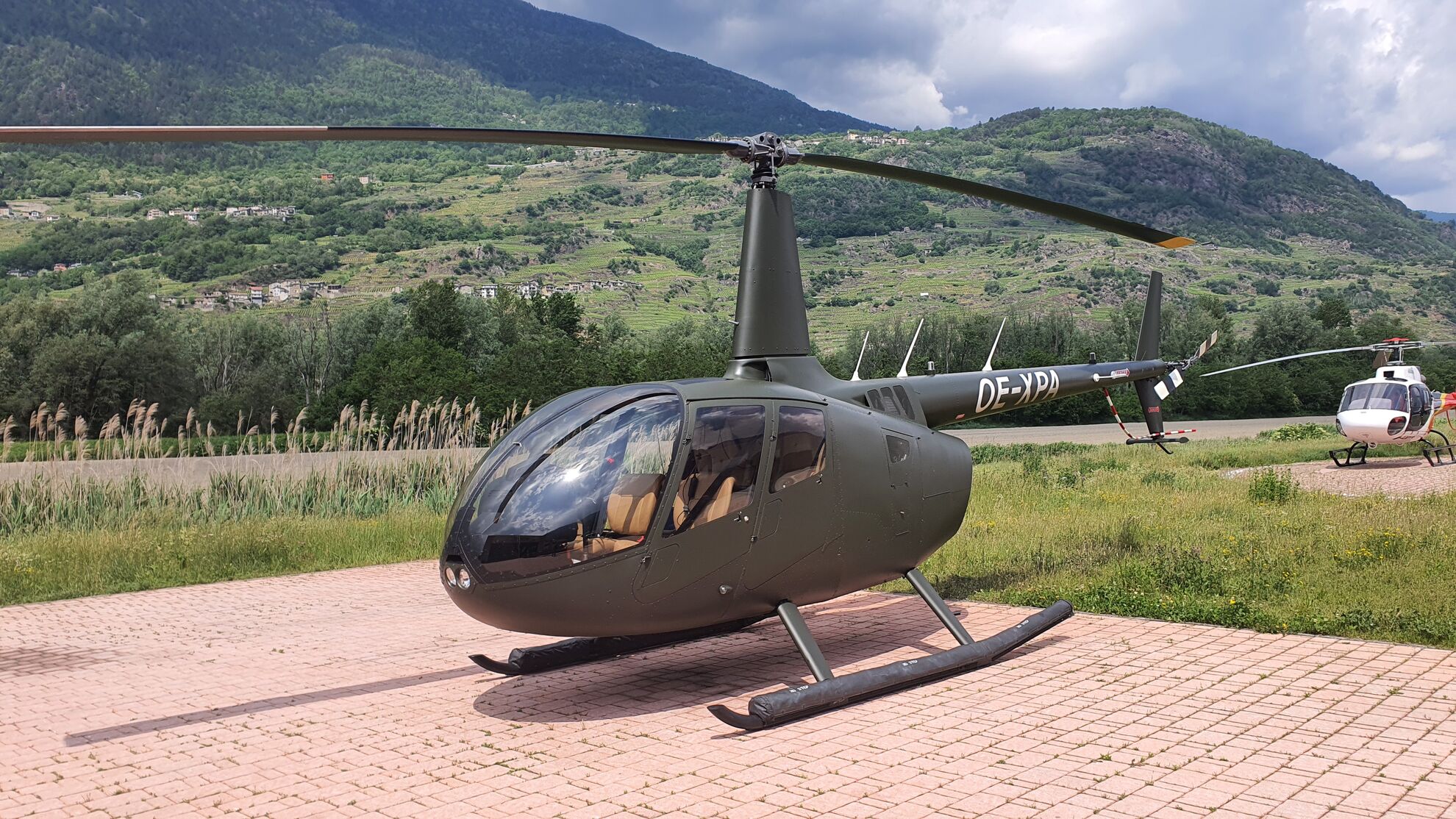
The aircraft chosen to do it is the Robinson R66.
The decision says a great deal about how an effective training system is built, and about what keeps it running.
From Eurotech's perspective, as an official Robinson Service Center, it says something more specific still: how much depends on maintenance carried out to a consistent standard, and on keeping a helicopter available to fly.
The Flight School Next programme and Robinson's role
Until now, the US Army has trained its student pilots on aircraft it owned outright, UH-72 Lakotas, twin-engine machines, modern and comparatively complex.
On 13 August 2026 the Army announced the award of its Flight School Next programme to M1 Support Services, under a contract with a stated potential value of up to ten billion dollars and a possible duration of twenty-six years. The aircraft selected for the programme, as confirmed by Robinson Helicopter Company, is the Robinson R66 Turbine.
The change goes beyond the choice of training helicopter. It reshapes the entire concept of the flight school. Under a contractor-owned, contractor-operated arrangement, the Army no longer purchases aircraft alone, but a complete service:
- Aircraft
- Maintenance
- Simulators
- Instructors
The Army retains for itself the definition of standards and the oversight of safety. One integrated solution, in place of the separate contracts currently in force.
Why the Robinson R66
According to industry reporting, the selection of the Robinson R66 Turbine followed a clearly defined idea: not the most advanced helicopter, but a single-engine turbine with fewer automated handling aids. The reasoning is educational before it is anything else. A student flying an aircraft that corrects too many of his mistakes takes longer to stop making them.
The R66 has everything a training helicopter requires. It is a single-engine turbine that obliges the pilot to build the fundamentals of handling, without giving up a modern cockpit: Garmin G500H TXi and GTN 750 avionics, three-axis autopilot and night vision compatibility. Instrumentation the student will meet again, in comparable form, on the aircraft he goes on to fly.
Alongside the technical and instructional case, the R66 selection also rested on Robinson's industrial base and on economic considerations stated by the manufacturer:
- The lowest acquisition cost and lowest direct operating cost in its class over the past decade
- More than 2.5 million flight hours accumulated without an engine failure
- Over 85% of components manufactured in-house at the Torrance facility
These are figures declared by the manufacturer, but they indicate the logic behind the selection. At this scale, up to 1,500 students a year, what an hour of flying costs, and how many helicopters are actually ready to depart, are not administrative details. They determine how many pilots the programme is able to produce.
Why helicopter maintenance is the deciding factor
A flight school fleet works to a demanding rhythm: repeated landings, simulated autorotations, extended hovering. All manoeuvres that load rotors, transmissions and controls at a frequency no private operation ever reaches.
For this reason, the real constraint on a training programme is rarely the number of helicopters available. It is the ability of a maintenance organisation to keep them on the flight line.
Scheduled inspections, management of component life limits, spares availability, documentary traceability, these are what determine how many flying hours a student actually completes over the course of his training.
Robinson has indicated that the start of the programme will bring a further strengthening of the parts, support and training infrastructure already serving the worldwide network of Robinson Service Centers, Eurotech among them.
Robinson helicopter maintenance at Eurotech
Eurotech operates as a Robinson Service Center and covers the R22, R44 and R66 series as an EASA Part 145 Approved Maintenance Organisation.
On these models, line and base maintenance capabilities cover the work that intensive operation makes routine: inspections on rotor and transmission components, propeller and rotor balancing developed through the collaboration with Honeywell–Chadwick Helmuth, structural repairs, and troubleshooting of electrical and avionic systems.
The decision taken for Flight School Next does not change the daily work of a maintenance centre such as ours. It does confirm a principle that matters: a helicopter is worth what it is ready to fly when needed, and that depends entirely on how it is maintained. It holds true for the US Army's training fleet, and equally for a single operator's aircraft.
This is precisely the work Eurotech has been doing since 1995.
